

 Si3 by UJIA
About the JCD Fund in UJIA
The JCD Fund in UJIA supports programmes that improve the safety, wellbeing, development and life chances of Jewish children and young people under 18 in the UK and Israel.
The Fund is focused on children and young people who are experiencing financial hardship, disadvantage, vulnerability or need, especially where support can remove barriers, prevent harm, improve wellbeing, or strengthen stability and development.
What does the Fund Support?
What We Do Fund (Core Areas)
Applications and grant awards for the UK will only be between £5,000 and £25,000
Applications and grant awards for Israel will only be between £10,000 and £25,000
| Category | Description | This may include (examples) |
|---|---|---|
Access to Education and Development |
Supporting children to access, participate in, and benefit from educational and developmental opportunities where financial or other barriers would otherwise prevent this. |
|
Physical Health, Mental Health and Wellbeing |
Supporting children whose physical, emotional, or mental health needs are unmet or where early intervention is required to prevent harm or deterioration. |
|
Safety, Stability and Basic Needs |
Supporting children whose home or financial circumstances place them at risk and where timely intervention is required to safeguard wellbeing and stability. |
|
In limited circumstances, the Fund may support essential general equipment or infrastructure costs where there is a clear, direct and evidenced benefit to Jewish children in need and a demonstrable link to one of the core areas above.
What We Don't Fund
What We Do Not Fund
The JCD Fund does not normally fund:
- Activities where the primary or demonstrable benefit is not to Jewish children.
- Work that falls outside the JCD’s Objects or UJIA’s grant allocation parameters.
- Political activity, lobbying, or partisan campaigning, whether direct or indirect, even if these activities are permissible according to CC9 (Link).
- Projects or organisations that do not meet acceptable safeguarding standards.
- Applications lacking appropriate governance, financial controls, or accountability structures.
- Costs that cannot be clearly evidenced, justified, or monitored.
The JCD Fund reserves the right to decline applications that fall outside its strategic priorities or where risks cannot be mitigated to an acceptable level.
Who Can Apply?
Eligibility
In round one, opening July 2026, applications will only be accepted if the organisation was previously awarded a grant from Jewish Child’s Day within the last five years.
Applications are accepted from the following types of organisations:
| Jurisdiction | Eligible forms |
|---|---|
United Kingdom |
|
Israel |
|
General
|
|
Individuals are not eligible to apply in a personal capacity.
Organisations that do not meet the eligibility criteria should not proceed unless they have been specifically invited by UJIA to do so.
How To Apply?
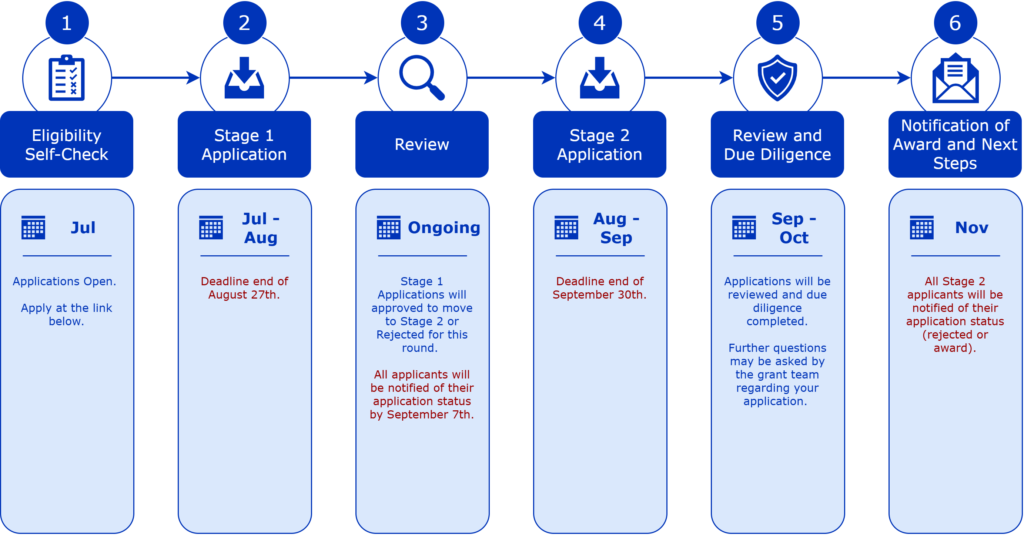
Eligiblity Self-Check
This is a short initial check to confirm whether the organisation and programme appear to be eligible. It is not a full assessment of the application.
Applicants will be asked to confirm that:
The programme is delivered in the UK or Israel.
The organisation is eligible to receive UJIA funding.
The programme sits within one of the Fund’s core areas.
The organisation has received a Jewish Child’s Day grant within the last five years.
If an applicant cannot confirm these points the application cannot proceed.
Stage 1 Application
Stage 1 is a short application designed to help UJIA understand whether the proposal is a good strategic fit before asking applicants to complete a fuller form.
Applicants will be asked for:
– Organisation and contact information.
– A short description of the organisation’s vision and mission.
– The relevant JCD Fund core area.
– Programme title and whether the programme is new or ongoing.
– A short programme description.
– Age range and number of participants.
– A description of the target participants.
– Headline financial information, including organisation income, expenditure, total programme cost, grant amount requested, and other funding secured.
Applicants should keep Stage 1 concise. The purpose is to establish fit, need, scale and basic deliverability, not to provide a full business case
Stage 2 Application
Stage 2 is a fuller application for proposals that appear eligible and potentially fundable after Stage 1.
Applicants will be asked for more detailed information on:
– Organisation registration, governance and board members.
– Key staff and relevant professionals involved in delivery.
– Any legal disputes involving the organisation, staff or board members.
– Programme purpose, activities and target participants.
– Challenges or opportunities the programme seeks to address.
– How the programme differs from similar provision in the ecosystem.
– How the programme will reach target participants.
– Logic model or theory of change.
– Previous or planned evaluation.
– Full programme finances and other secured funding.
– Financial risks, reserves or sustainability considerations.
– Safeguarding policy, safeguarding lead, training, reporting and recruitment procedures.
– Declaration confirming accuracy, restricted use of funds, notification of changes, due diligence and monitoring requirements.
Application Guide
What makes a strong application?
A strong application will usually show:
– A clear fit with one or more of the JCD Fund’s core areas.
– A clear focus on Jewish children and young people under 18.
– Specific evidence of hardship, disadvantage, vulnerability or need.
– A clear explanation of what will be delivered.
– A realistic number of participants.
– A credible route to reaching the children who most need the support.
– Clear intended outcomes for children.
– A budget that is proportionate, realistic and transparent.
– Evidence that the organisation has the capacity to deliver safely and effectively.
– Appropriate safeguarding arrangements.
– A willingness to report honestly on outputs, outcomes, challenges and learning.
The Fund is not looking only for the highest number of participants. Smaller projects may be strong where the need is acute, the support is meaningful, and the expected benefit to children is clear.
What may weaken an application?
An application may be less likely to proceed if:
– The primary benefit is not clearly for Jewish children under 18.
– The application describes general organisational activity rather than a defined programme.
– The need is broad, unclear or not evidenced.
– The link to the Fund’s core areas is weak.
– The programme appears duplicative and the applicant does not explain why it is needed.
– The budget is unclear, inflated or not linked to the proposed activity.
– The applicant cannot show how participants will be reached or prioritised.
– Safeguarding arrangements are missing, outdated or unclear.
– There are unresolved governance, legal, financial or reputational risks.
– The application does not provide enough information for UJIA to make a responsible funding decision.
Proportionality
UJIA will take a proportionate approach to assessment. This means that the level of information requested in application and due diligence may reflect the:
– The complexity of the programme.
– The vulnerability of the children supported.
– The level of safeguarding, financial, operational or reputational risk.
– Whether UJIA already knows the organisation and its work.
Applicants may be contacted for clarification as part of the process. A request for clarification does not mean the application will be funded, but it may help UJIA understand the proposal more fairly.